Blog Topic: Fertility testing

  • Understanding Male Fertility Testing

    Understanding Male Fertility Testing


    Blog
    Fertility testing

    Understanding Male Fertility Testing

    Learn about male fertility: how to test male fertility, indication and considerations, and at-home male fertility tests.

    Understanding Male Fertility Testing

    By Constance McGraw, MPH

    Men’s fertility testing is very important for couples facing conception difficulties, attributing to 40-50% of infertility cases. Additionally, about 20% of infertility cases are for reasons solely related to male fertility, as per the American Society for Reproductive Medicine. Early identification of fertility problems allows prompt intervention and accurate diagnosis. Common male fertility issues involve:

    • inadequate sperm production
    • abnormal sperm morphology (shape) or motility (movement)
    • reproductive tract blockages hindering sperm release

    How to Test Male Fertility: Essential Steps for Men’s Fertility Testing

    Following a year of trying to conceive without success (or six months for female partners over 35), both partners should undergo fertility evaluations.  Additionally, According to the American Urological Association, in couples with failed ART (assisted reproductive technologies) cycles or recurrent pregnancy losses (RPL) (two or more losses), evaluation of the male should be considered. 

    For men, fertility testing may include:

    • Health History: Detailed exploration of medical, family, and fertility history.
    • Physical Exam: Thorough diagnostic examination.
    • Blood Test: Assessment of reproductive hormone levels to identify potential imbalances affecting fertility.
    • Lab-Based Semen Analysis: Crucial for assessing sperm count, volume, shape, and motility.
    • Scrotal ultrasound imaging that can test for testicular obstruction.
    • Genetic testing- to confirm potential genetic issues with sperm concentration.
    • Testicular biopsy-piece of tissue from the testicle removed and examined under a microscope.
  • Understanding your fertility results: AMH test, FSH and LH test, estradiol

    Understanding your fertility results: AMH test, FSH and LH test, estradiol


    Blog
    Egg freezing

    Understanding your fertility results: AMH test, FSH and LH test, estradiol

    Learn how to interpret your fertility test results: estradiol test results, AMH, and FSH results.

    Understanding your fertility results: AMH test, FSH and LH test, estradiol

    By Constance McGraw, MPH

    Testing blood hormone levels is crucial when exploring fertility concerns or contemplating treatment cycles like IVF or egg retrieval. Several of these key tests, including Anti-Müllerian Hormone, follicle-stimulating hormone (FSH), luteinizing hormone (LH) and estradiol (E2), offer insights into ovarian reserve, indicating egg quantity and quality. These are often called ‘Day 3’ tests because they are conducted on the third day of your menstrual cycle to precisely measure these hormone levels, guiding adjustments in treatment plans during fertility treatments.

    AMH test results

    AMH (Anti-Mullerian Hormone) is a popular hormone blood test that is typically used to examine ovarian reserve and response to fertility treatments. AMH tests can also assist with understanding how close women are to menopause. Key points about results of AMH tests include:

    • AMH levels typically stay stable throughout the menstrual cycle, allowing testing at any time.
    • High AMH: ≥5.0 ng/mL (can indicate PCOS ~2-5 x higher than normal range for age
    • Average AMH: 1.0 ng/mL-3.0 ng/mL (depends on age, testing method, manufacturer)
    • Low/severely low AMH: 0.4-1.0 ng/mL (low or diminished ovarian reserve)
    • Age significantly impacts AMH levels, with a natural decline post-35 impacting fertility potential.

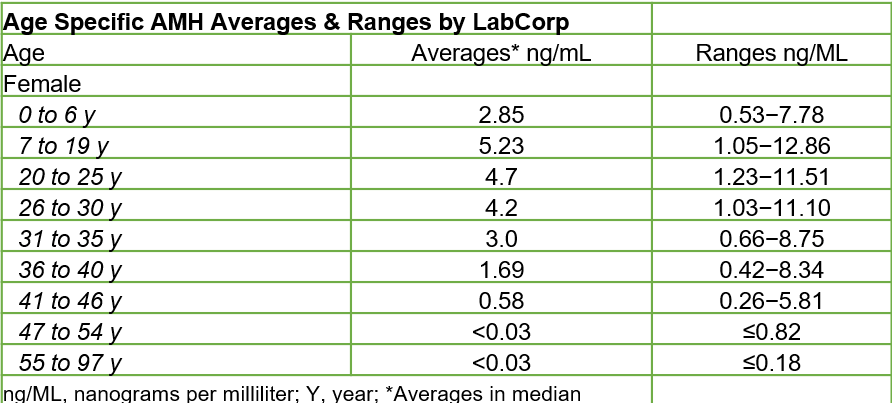
    Below are some common AMH lab values used by LabCorp to determine appropriate ranges of AMH based on a woman’s age. Please consult with a medical provider before making your own interpretations.

  • Cost of Freezing Eggs in California & Affordable Fertility Clinics for Egg Freezing

    Cost of Freezing Eggs in California & Affordable Fertility Clinics for Egg Freezing


    Blog
    Clinics

    Cost of Freezing Eggs in California & Affordable Fertility Clinics for Egg Freezing

    Understand the cost of freezing eggs in California and find the cheapest fertility clinics in California for egg freezing.

    Cost of Freezing Eggs in California & Affordable Fertility Clinics for Egg Freezing

    It is great that you are considering preserving your fertility. Being proactive about your health is so important. Before you even fully commit to egg freezing, it is smart to: 

    • Go through fertility testing consultation at a fertility clinic (usually includes bloodwork and transvaginal ultrasound and is performed at a fertility doctor’s office)
    • Understand the cost of egg freezing because it varies greatly depending on your location, clinic’s reputation and popularity, and employer insurance coverage. 

    We will look deeper into all these aspects for IVF cost in California.  

    The process of freezing eggs

    Includes the following steps:

    1. Fertility assessment (usually includes bloodwork and transvaginal ultrasound and is performed at a fertility doctor’s office)

    2. Preparation (including information on medications and lifestyle changes)

  • How much is IVF in California?

    How much is IVF in California?


    Blog
    Clinics

    How much is IVF in California?

    IVF cost in California varies from $15,000 to $40,000. California doesn't require insurers to cover IVF treatment, so your coverage depends on your employee benefits. Save money by flying to another state, applying for fertility grants, or even changing jobs.

    How much is IVF in California?

    Find the best fertility clinic in California with cost and success rates

    What is IVF?

    In Vitro Fertilization is a type of fertility treatment that involves combining an egg and sperm outside the body in a laboratory dish. Once fertilized, the embryo is then transferred into the uterus. IVF is a blessing for couples struggling with infertility, but it’s essential to be prepared for the associated costs. 

    Breaking Down of the Cost of IVF in California

    • IVF Clinical Cost: The cost of a single IVF cycle or procedure in California can range from $12,000 to $30,000. It’s recommended to ask about what’s included in this cost, such as ultrasounds, blood tests, embryo transfers, ICSI (Intracytoplasmic Sperm Injection), and anesthesia. Preliminary testing for both partners is needed before starting the IVF process, and it is not included in the cycle cost. 
    • IVF Medication Cost: IVF requires various medications to stimulate egg production, trigger ovulation, and support the uterine lining. These medications can significantly contribute to the overall cost, and the individual protocol depends on your medical history and doctor’s recommendations. On average, IVF medication costs can range from $3,000 to $10,000, depending on the individual’s needs.
  • OBGYN and infertility

    OBGYN and infertility


    Blog
    Egg freezing

    OBGYN and infertility

    In this blog post, we will discuss the role of OBGYNs in infertility, exploring what they do, how they differ from fertility specialists, and their ability to diagnose and treat infertility.

    OBGYN and infertility

    To start with, I want to address the differences between OBGYN and fertility doctor/reproductive endocrinologist (REI)

    An OBGYN specializes in obstetrics (pregnancy) and gynecology (reproductive health), offering general women’s healthcare and managing pregnancies. An infertility specialist (REI) is an OBGYN with extra training in diagnosing and treating infertility, including advanced reproductive technologies like IVF. OBGYNs provide routine care, while infertility specialists focus on complex fertility issues and treatments.

    Your local OBGYN can do a part of fertility treatment (IVF or egg freezing) under the supervision of a fertility doctor. Blooming Eve helps to set it up. Book a time for a consultation if you want to do part of IVF/egg freezing at your local OBGYN

    What Does OBGYN Do for Infertility?

    OBGYNs are medical doctors who specialize in women’s health, including pregnancy, childbirth, and disorders of the reproductive system. When it comes to infertility, OBGYNs play multiple roles:

    Initial Evaluation: OBGYNs are often the first point of contact for individuals or couples struggling with infertility. They conduct thorough evaluations to identify potential causes of infertility, which may involve reviewing medical history, performing physical examinations, and ordering diagnostic tests.

    Diagnostic Testing: OBGYNs can perform various tests to assess reproductive health and identify potential causes of infertility. These tests may include hormone level assessments, imaging studies (such as ultrasound), and evaluations of ovulation and menstrual cycles.

    Treatment Recommendations: Based on the findings from diagnostic tests, OBGYNs can provide personalized treatment recommendations. This may include lifestyle modifications, medications to stimulate ovulation, surgical interventions to correct anatomical issues, or referrals to fertility specialists for advanced treatments.

    Available only through Blooming Eve – Monitoring for more advanced infertility treatments: For some patients – more advanced fertility treatments may be required, such as egg freezing or IVF. For these patients, OBGYN can do monitoring during the treatment including bloodwork and follicular count (ultrasound). Book a time for a consultation if you want to start your IVF with your local OBGYN.

    What is the Difference Between Fertility and OBGYN?

    While OBGYNs specialize in women’s health, fertility specialists, also known as reproductive endocrinologists, undergo additional training specifically focused on diagnosing and treating infertility. Here are some key differences between the two:

    • Specialization: Fertility specialists have advanced training in reproductive endocrinology and infertility, allowing them to specialize solely in the diagnosis and treatment of infertility. OBGYNs, on the other hand, have a broader focus on women’s health, including obstetrics, gynecology, and reproductive health.
    • Advanced Procedures: Fertility specialists are equipped to perform advanced procedures such as assisted reproductive technologies (ART), including IVF and egg freezing. While OBGYNs may offer some basic fertility treatments, they typically refer patients to fertility specialists for more complex procedures. 
    • Collaboration: OBGYNs and fertility specialists often collaborate to provide comprehensive care for individuals or couples struggling with infertility. OBGYNs may conduct initial evaluations and basic treatments, while fertility specialists handle more specialized interventions when necessary. With Blooming Eve, you can also start your IVF at your local OBGYN. Reach out to learn how.

  • IVF Cost in Los Angeles: What You Need to Know

    IVF Cost in Los Angeles: What You Need to Know


    Blog
    Clinics

    IVF Cost in Los Angeles: What You Need to Know

    Learn about IVF costs in Los Angeles, the average cost of IVF in Los Angeles, and ways to save money on your IVF

    IVF Cost in Los Angeles: What You Need to Know

    In vitro fertilization (IVF) stands as one of the most advanced and effective options available for couples struggling to conceive. However, alongside the emotional journey of infertility treatment comes the practical consideration of cost, which can vary significantly depending on various factors.

    In Los Angeles, with its high cost of living and high healthcare costs, understanding the financial aspects of IVF is crucial for hopeful parents-to-be. Let’s break down the IVF costs in Los Angeles and discuss how individuals can navigate this aspect of their fertility journey.

    Breakdown of IVF Costs

    Before diving into specific figures, it’s essential to understand what the cost of IVF typically includes. IVF is a multi-step process that involves ovarian stimulation, egg retrieval, fertilization of eggs with sperm in a laboratory setting, embryo culture, and embryo transfer. The overall cost of IVF usually consists of:

    • Medical Procedures: This includes consultations, monitoring appointments, ultrasounds, blood tests, egg retrieval or embryo transfer. The initial consultation and testing can usually be covered by your general insurance as a part of diagnostics. Other services costs would depend on your fertility benefits from your employer.
    • Fertility Medications: IVF often requires medications to stimulate the ovaries to produce multiple eggs. These medications can be a significant portion of the overall cost and range from $3,000 to 10,000. It can be partly covered by your general insurance or employer fertility benefits.
    • Laboratory Services: Costs associated with the fertilization of eggs, embryo culture, freezing if necessary and any additional laboratory procedures such as genetic testing.
    • Additional Services: This may include pre-cycle fertility testing and workup, anesthesia during procedures, cryopreservation of embryos, and embryo storage.
    • Fees and Administration: Administrative fees charged by the fertility clinic, as well as fees for services such as counseling or support groups.
  • Fertility Check for Couples: Where, What to Test, Insurance Coverage

    Fertility Check for Couples: Where, What to Test, Insurance Coverage


    Blog
    Clinics

    Fertility Check for Couples: Where, What to Test, Insurance Coverage

    Where to Start Fertility Check for Couples, fertility check female and male, free fertility assessment and insurance.

    Fertility Check for Couples: Where, What to Test, Insurance Coverage

    Fertility testing is a proactive step for couples aiming to conceive. It offers valuable information about your reproductive health, allowing you to make informed decisions and potentially address any issues that may hinder your fertility.

    Fertility test for women consists of and where it can be done at:

    • Egg Count Ultrasound Test (which needs to be done at a fertility clinic or OBGYN):
      This test, also known as an ovarian reserve test, measures the quantity of eggs remaining in a woman’s ovaries with an ultrasound. It’s a critical indicator of fertility potential.
    • Blood Test for Fertility (can be done both at home or at a fertility clinic, depending on what your insurance covers)
      Blood tests can provide insights into your hormone levels, helping to identify any hormonal imbalances that could affect fertility.

    Fertility test for men consists of and where it can be done at: