Blog Topic: IUI

  • Gender Selection through IVF: Can You Choose Your Baby’s Gender?

    Gender Selection through IVF: Can You Choose Your Baby’s Gender?


    Blog
    Clinics

    Gender Selection through IVF: Can You Choose Your Baby's Gender?

    Learn about gender selection using IVF, its cost implications, and alternative methods for those interested in family planning.

    Gender Selection through IVF: Can You Choose Your Baby's Gender?

    Introduction

    Advancements in reproductive technology have opened up numerous possibilities for couples seeking to have a child. Gender selection became possible with the invention of preimplantation genetic testing for aneuploidy (PGT-A) used before embryo transfer in IVF. The use of the technology in IVF cycles has increased in recent years, as well as the number of cycles with known sex of the embryos.

    Alternative methods for gender selection

    There are two main exiting methods for gender selection:

    • Preimplantation genetic testing (PGT-A) is a method to screen the embryo for any chromosome abnormalities where a few cells are removed from the embryo for testing.
    • Sperm separation method – is a method to identify X or Y-chromosome-bearing sperm based on its different characteristics such as size, shape, and motility pattern. Sperm separation can be used both for IUI and IVF

    While the sperm separation method has been used in animals for more than 20 years, there were questions about its precision, and it hasn’t been approved by the FDA, and PGT-A is a more reliable method used by most fertility centers.

    Can You Choose Gender with IVF?

    The short answer is yes, you can choose your baby’s gender through IVF, but it’s essential to understand the process and its ethical implications. Gender selection through PGT-A testing is typically used for medical reasons, such as preventing the transmission of gender-specific genetic disorders or diseases. In some cases, couples may choose gender for non-medical reasons, which is totally a personal decision. Clinics may have different policies around the use of PGT-A, so it is important to discuss your goals with your doctor before signing PGT-A consent forms. 

    IVF Cost for Gender Selection

    The cost of IVF with gender selection can vary significantly from clinic to clinic. It is rarely included in the IVF cycle price and is usually at an additional cost. 

    The price of genetic testing of embryos includes the following elements:

    • Embryo biopsy: This is billed by your fertility clinic for taking tissues from the embryo and preparing it for testing
    • Genetic laboratory fees: This is the cost of an external laboratory that performs the genetic testing of the embryos.  

    The price depends on the number of embryos tested and, in total, can come up to $4,000-5,000. It’s crucial to consult with fertility clinics in your area and request detailed cost breakdowns.

    Ethical Considerations

    Gender selection for non-medical reasons raises ethical questions about gender equity and the potential for gender bias. Many countries and regions have regulations and guidelines governing the use of IVF for gender selection to prevent misuse and ensure that the procedure is not abused for societal preferences. 

    In the United States, regulation of PGT would fall to individual states; however, no state currently has laws regulating the use of PGT. Individual clinics may use their own guidelines, and it’s essential to discuss your clinic’s policy in advance.

    Conclusion

    Gender selection through IVF is a complex and controversial topic with various ethical, medical, and financial considerations. While it is possible to choose your baby’s gender through IVF, it’s essential to do thorough research, consult with fertility specialists, and consider the ethical implications before making a decision. Ultimately, the decision should align with your values, priorities, and the regulations of your region. If you are ready to start with your IVF process, you can find an IVF clinic near you with costs and success rates.

  • Understanding IUI Cost, Success Rate and IUI process

    Understanding IUI Cost, Success Rate and IUI process


    Blog
    Clinics

    Understanding IUI Cost, Success Rate and IUI process

    The cost & success rate of IUI & IVF – consider before you choose. Learn about IUI vs. IVF, the IUI cost & success rates by age, the IUI process, and its timeline.

    Understanding IUI Cost, Success Rate and IUI process

    IUI vs. IVF: Understanding the Basics

    Before we analyze the cost and success rates of IUI, let’s clarify the fundamental differences between IUI and IVF.

    IUI, or Intrauterine Insemination, is a less invasive fertility treatment where sperm is directly placed into a woman’s uterus during her fertile window, increasing the chances of sperm reaching and fertilizing the egg. IVF, on the other hand, stands for In Vitro Fertilization, a more complex and expensive procedure involving the retrieval of eggs from the ovaries, fertilization outside the body, and the transfer of embryos into the uterus.

    IUI Cost: How Much is IUI?

    One of the primary factors couples consider when contemplating fertility treatments is cost. The cost of IUI can vary widely depending on factors such as location, the clinic chosen, and the specific treatment plan. On average, an IUI cycle can range from $2,000 to $7,000 with medication per attempt. However, it’s important to note that this cost may not include additional expenses, such as ultrasounds, and lab tests, which can add to the overall price.

    IVF vs. IUI: A Cost Comparison

    Comparatively, IVF is typically more expensive than IUI. The cost of a single IVF cycle with medication in the United States can range from $6,500 to $40,000. This price tag includes the entire IVF process, from egg retrieval to embryo transfer. Check and compare IVF costs at different clinics near you using our database. Considering the financial aspect alone, IUI is often seen as a more cost-effective option.

    IUI Success Rate by Age

    While cost is a significant consideration, another crucial aspect is the success rate of IUI, which can vary depending on a person’s age and other individual factors.

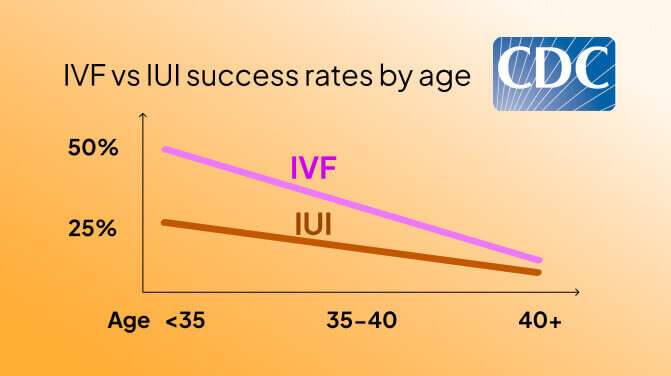
    For women under 35, the success rate for IUI ranges from 8% to 15% per cycle (Belloc, 2018). As women age, the success rate tends to decline, with a decrease of 10-15% for women between 35 and 40 years old and even lower for those over 40. Below, you can find the comparison of IVF and IUI success rates by age.

    It’s essential to consult with a fertility specialist who can provide personalized insights into your specific situation. Find the best fertility doctor near you.

    The IUI Process and Timeline

    Understanding the IUI process and timeline is essential for those considering this fertility treatment. The typical IUI process has the following steps:

    • Day 1 – The start of your cycle 
    • Day 2 or 3 – First appointment and ultrasound 
    • Days 3-7 –  Medication stimulation that will help to produce more eggs and increase chances of fertilization
    • Day 10-13 – Monitoring appointments to check how follicles (future eggs) are growing (usually ultrasound screening).
    • Day 13 – Trigger shot to provoke ovulation
    • Day 14 or 15 – IUI procedure. During the doctor’s visit, the sperm sample is “washed” in the lab to separate active sperm, which then is transfered into the female uterus. The sperm transfer itself takes only 1-2 minutes.  
    • Day 28 – Pregnancy test 

    Keep in mind that this is just a typical timeline, and it could differ depending on your personal circumstances and doctor’s recommendations.

    Conclusion

    In summary, when exploring fertility treatments like IUI, it’s crucial to consider both the financial aspect and the associated success rates. While IUI is generally more affordable than IVF, success rates can vary based on age and individual factors. It’s recommended that couples seeking fertility treatment consult with a fertility doctor. Find the best fertility clinic near you.

  • How much does IUI cost?

    How much does IUI cost?


    Blog
    Clinics

    How much does IUI cost?

    IUI cost: IUI procedure, medication & treatment monitoring costs, and other considerations.

    How much does IUI cost?

    Introduction

    Intrauterine Insemination (IUI) is often a viable and less invasive fertility treatment option for individuals and couples on the journey to parenthood. However, understanding the cost of IUI and what factors contribute to it is crucial in making informed decisions about your fertility journey. 

    What is IUI?

    Before we dive into the cost details, let’s briefly review what IUI entails. Intrauterine Insemination, commonly known as IUI, is a fertility treatment where sperm is placed directly into the uterus during a woman’s ovulation period. This procedure aims to increase the chances of fertilization by bypassing potential barriers the sperm may encounter on its journey to the egg.

    IUI Costs: The Breakdown

    IUI Procedure Cost: 

    The core cost of IUI includes the procedure itself, where a trained healthcare provider places prepared sperm directly into the uterus. The price of this step can vary based on factors such as your location, the medical facility you choose, and whether or not you have insurance coverage for fertility treatments. On average, the basic IUI procedure can range from $1,500 to $3,000 per cycle.

    Fertility Medications:

     In many cases, fertility medications are prescribed to stimulate the ovaries and increase the chances of successful ovulation. The cost of these medications can add up significantly, ranging from $500 to $4,000 per cycle. Whether you require medication and the specific type will depend on your individual circumstances.

    Monitoring and Testing: 

    Before and during the IUI process, you’ll likely need to undergo several tests and monitoring procedures. These may include ultrasounds, blood tests, and sperm analysis. The cost of these tests can vary, but budgeting an additional $500 to $1,000 for monitoring and testing is a prudent estimate.

    Additional IUI Cycles:

    It’s essential to understand that success rates for IUI can vary. Learn more about IUI success rates vs. IVF in our recent blog post. Multiple cycles may be necessary to achieve pregnancy. Each additional IUI cycle will incur its own set of costs, including the basic procedure, medications, and monitoring.

    Overall costs for one IUI procedure may be anything from $2,000 to 7,000 without insurance coverage.

    Insurance Coverage for IUI

    The availability of insurance coverage for IUI varies widely. Some insurance plans may cover a portion of the costs, while others may not cover fertility treatments at all. It’s crucial to check with your insurance provider to understand your coverage and any associated limitations. If your insurance does not cover IUI, you’ll need to budget for the full cost on your own.

    Financial Assistance and Support

    Navigating the cost of IUI can be challenging, but there are resources available to help ease the financial burden. Consider exploring the following options:

    • Fertility Grants and Scholarships: Some organizations offer grants and scholarships to individuals and couples seeking fertility treatment, including IUI. Check here the list of fertility grants that you can apply to.
    • Fertility Financing: Many fertility clinics offer financing options to help you spread the cost of IUI over time. These programs can make fertility treatments more accessible.
    • Employer Benefits: Some employers provide fertility benefits that may cover a portion of your IUI costs. Check with your HR department to see if your company offers such benefits.
    • Tax Deductions: IUI cost can be tax deductible if it is related to infertility. You would need to have all your expenses itemized and proven by receipts. For more details on what expenses are eligible for deduction, consult your tax advisor.

    Conclusion

    The cost of IUI can vary widely, and it’s essential to consider all the factors involved when planning your fertility journey. While the financial aspect can be daunting, remember that there are options for financial assistance and support. Your fertility clinic and insurance provider can provide valuable information to help you make informed decisions about the cost of IUI and your path to parenthood. Book a consultation with a fertility doctor near you.

  • PCOS and IVF: A Comprehensive Guide to Fertility Treatment

    PCOS and IVF: A Comprehensive Guide to Fertility Treatment


    Blog
    IVF

    PCOS and IVF: A Comprehensive Guide to Fertility Treatment

    How PCOS affects your IVF, PCOS IVF success rates, IUI vs. IVF with PCOS, and other considerations.

    PCOS and IVF: A Comprehensive Guide to Fertility Treatment

    Introduction

    Polycystic Ovary Syndrome (PCOS) is a common hormonal disorder that affects 5-10% of women. One of the significant challenges that women with PCOS face is infertility. In Vitro Fertilization (IVF) is one of the fertility treatment options that has also been used in some cases for women with PCOS. In this blog, we will explore the relationship between PCOS and IVF, the success rates, protocols, and other important aspects of IVF for women with PCOS.

    Understanding PCOS and IVF

    PCOS is a condition characterized by irregular menstrual cycles, high levels of androgens (male hormones), and the presence of small cysts on the ovaries. These hormonal imbalances can lead to difficulties in ovulation, making it challenging for women with PCOS to conceive naturally. IVF is a medical procedure that involves fertilizing an egg with sperm outside the body, followed by the transfer of the embryo(s) into the uterus. It is often offered to women with PCOS who struggle to conceive naturally and have unsuccessfully tried ovulation induction.

    PCOS IVF Success Rate

    The success of IVF for women with PCOS depends on various factors, including the woman’s age, the severity of PCOS, and her overall health. Generally, the success rate for IVF in women with PCOS is encouraging. It is important to keep in mind that PCOS is often linked to obesity, and a higher BMI index can negatively affect IVF success rates. It may be recommended to introduce lifestyle changes to increase the chances of IVF. Our fertility advisors can help you find experts to prepare for your IVF cycle. Get help today.

    PCOS IVF Success First Time

    While some women with PCOS do achieve success with their first IVF cycle, it’s essential to understand that the number of cycles required can vary. Success on the first attempt depends on several factors, including the woman’s age, the severity of PCOS, and age. Some studies show that women with PCOS with a BMI less than 30 have higher success rates than women without PCOS undergoing IVF for the first time. Many women with PCOS do become pregnant through IVF, but for some, it may take multiple cycles to achieve success and may also require lifestyle changes. Book a consultation with a fertility specialist to assess your individual chances.

    Can I Do IVF If I Have PCOS?

    Yes, women with PCOS are eligible for IVF treatment. In fact, IVF is often recommended for women with PCOS who have been unable to conceive after ovulation induction. It’s crucial to consult with a fertility specialist who can assess your specific situation and recommend the most appropriate treatment plan. Find a fertility specialist near you.

    Best IVF Protocol for PCOS

    The best IVF protocol for PCOS depends on individual factors and should be determined by a fertility specialist. They will consider your age, the severity of PCOS, and your response to medications when designing the most suitable protocol for you.

    Does IVF Work for PCOS?

    IVF can be highly effective for women with PCOS who are struggling to conceive and tried multiple other treatments to induce ovulation. While success rates may vary, many women with PCOS have successfully become pregnant through IVF treatment. It offers hope and a viable solution for those facing infertility due to PCOS.

    IUI vs. IVF for PCOS

    The most common treatment of PCOS is timed intercourse with induced ovulation (clomiphene citrate); sometimes, letrozole or injected gonadotropin can be used. Intrauterine Insemination (IUI) is another fertility treatment option that may be considered along with IVF for women with PCOS after unsuccessful ovulation induction. While IUI can be an efficient and more affordable option for treating infertility versus IVF, there is not enough evidence demonstrating the benefit of adding IUI to ovulation induction versus timed intercourse. The success rates for IUI tend to be lower compared to IVF. IVF is generally recommended when other treatments have not yielded positive results.

    Conclusion

    IVF is commonly used as a secondary treatment for PCOS patients after ovulation induction has been unsuccessful. IVF offers a promising solution for these women. In some cases, to increase the results of your IVF treatment, lifestyle changes should be introduced first. While the journey may involve multiple cycles and various protocols, many women with PCOS have achieved their dream of parenthood through IVF. If you have PCOS and are considering fertility treatment, book a consultation with a fertility specialist who can help you choose the right treatment.